
Houers Pty Ltd – Becoming a Private Company
Please note that, at a Meeting of Members on May 20, 2019, on the recommendation of the Board of Directors, the Members of Houers Koöperatief Beperk approved that Houers Koöperatief Beperk be converted to a private company, in terms of section 62 (2) of the Cooperative Act 14 of 2005.

All the rights and liabilities are transferred from Houers Koöperatief Beperk to Houers Pty Ltd.
Please also note that although the business will henceforth be known as Houers Pty Ltd, the company’s bank account number, as well as tax numbers have not changed. Business continues in the same manner as before the conversion
Houers running on the sun – Our Solar System
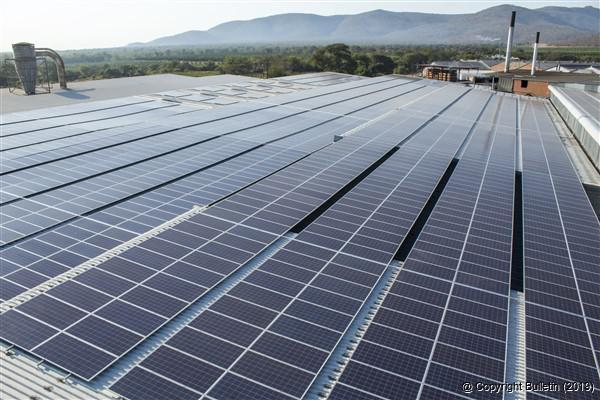
02-Jun-2019 Bulletin Tzaneen – With the amount of power outages plaguing the Tzaneen and surrounding areas, large corporations, farmers and industrial business particularly in the Letsitele area have started looking for alternative solutions to ease the incredible burden they face daily. With power supply to some areas interrupted for periods extending up to three days at a time, and with the municipality unable to cope, it has become paramount for the end user to seek solutions that would not only relinquish some of the strain on the aged infrastructure, but also ensure that production can continue uninterrupted.
It is in light of this that one pioneer in Letsitele has decided to take a leap into the solar power arena. Houers Koöperatief Beperk the largest and most trusted packaging provider in the area this week completed a three month-long solar panel installation which should see them running their operations largely off solar power.
Bulletin spoke to Tertius Erasmus, Plant Engineer at Houers Koöperatief Beperk on Wednesday morning and he explained that the system is fully integrated with the municipal power grid and backup generators which will ensure that their facility stays up and running even during power outages. A total of 3 820 solar panels each measuring 2m2 have been installed atop the main production facility’s roof. Special frames were installed to ensure that no shade covers any of the panels despite the roof being a tiered construction.
The system generates close on a Megawatt power. This is the maximum amount of power permitted to be generated without a special license which one would need to obtain from the National Energy Regulator, NERSA. In total, around 70 kilometres of cabling was used in the installation.
These panels harvest energy from the sun as direct current (DC) which is then transmitted to a series of inverters that convert the DC current into alternating current (AC) and feed it into the municipal substation that powers the facility. Three large generators are installed as backup and support for the solar system in case of prolonged outages.
“This is indeed a very exciting project for us and we are confident that we have made the right move here which will spark our neighbouring producers in this area to follow suit. The best analogy here is to liken the power grid to a long length of irrigation pipe. Every user plugs a sprinkler into the system and eventually the users at the end of the line will receive less water than those at the start of the line. By implementing our solar system, we have by no means cancelled out the municipality, but we have removed a few of our own sprinklers off the pipeline to lessen the load on the system,” explained Erasmus.
The solar panels are able to withstand the elements and even mild hailstorms should do very little damage. They have a lifespan of around 20 years after which they will be replaced and maintenance on the system is not very labour intensive as it needs to be cleaned once a month to remove dust and other particles from the panels and ensure that they function unencumbered.
BUSINESS Fruit Packaging
21-Jul-2017 Farmers weekly

Between 7 000t and 8 000t of paper are on the factory floor at any time.
A member shares in the profit of the company at the end of the financial year. Our goal is to keep costs low and supply a quality product at a highly competitive price Piet Smit, the current chairperson, says that Houers members form “a unique group of “a producers who are successful business people in their own right.
Members fully realise the value of cooperating and involving themselves in the cost and value chain.” The cooperative is structured so that all members have equal rights and a say in the business. Although a noble principle, this can sometimes inhibit the cooperative’s ability to move quickly, admits Smit. Despite this drawback, Houers “constantly meets the expectations of our customers, who demand quality packaging material at competitive prices and outstanding service

CARTONS ON DEMAND
Houres’ success is based on exploiting a gap in the market. Because crop production is unpredictable, it is difficult for farmers to order cartons well in advance. Carton manufacturers usually prioritise their bigger, more profitable clients, and do not necessarily take fluctuations in production into account. This can result in late delivery for some farmers at critical times during the harvest and packing seasons.
By contrast, Houers stays flexible and supplies cartons as required.” Because we’re focused on the agricultural market, our business model is designed to prepare for the various fruit seasons well in advance. We’re also prepared to adapt to any changes during the season,” explains Mostert. “Although most of the cartons we manufacture supply cartons for all agricultural products, including tropical and subtropical produce, vegetables, meat, eggs, and dairy produce.”

TIES WITH LOCAL SUPPLIERS
Houers’ approach includes forging long-term relationships with local suppliers.
“We need to support our local suppliers,” stresses Mostert. “If local suppliers should ever close their doors, we’ll all be at the mercy of foreign suppliers.”
Houers always buys its paper from MPact Paper and Sappi, a strategy that has paid off. “Our loyalty has never gone unrewarded. Our plant has never been without paper, even when supply was under severe pressure.”
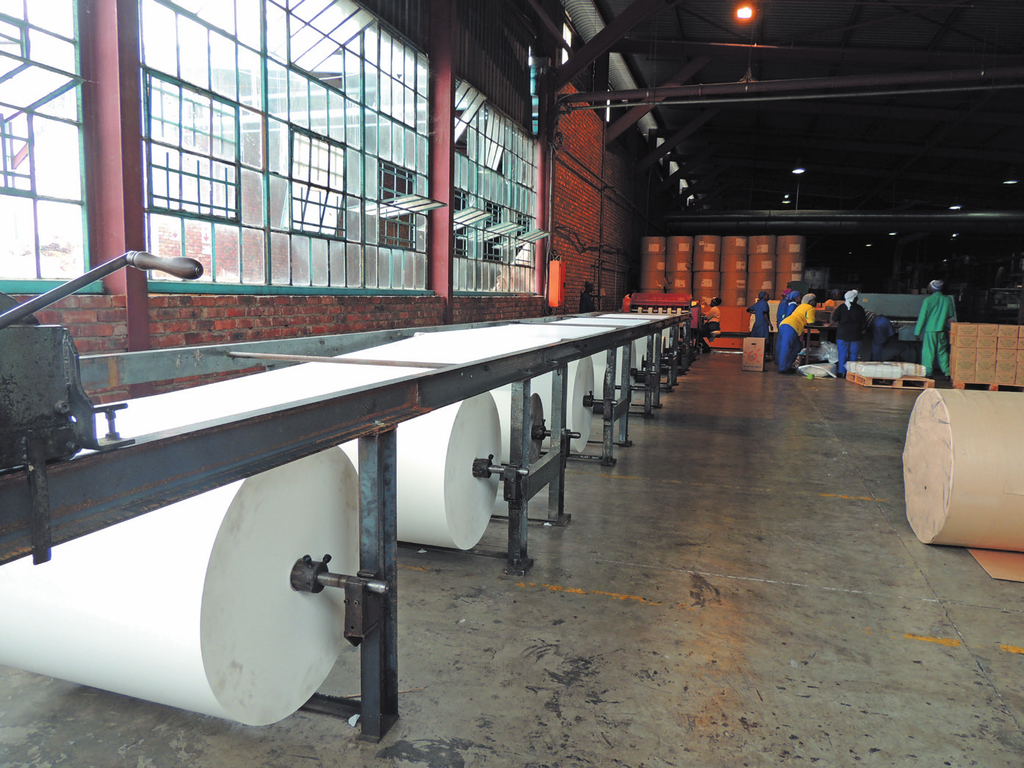
Houers expanded into producing fruit wrappers. This machine cuts the paper to size and shape
THE CHALLENGES OF EMPOWERMENT
By consulting regularly with experts in the field, Houers ensures that it adheres to new and amended statutory requirements. But BEE requirements are a significant concern, admits Smit. He explains that Houers’ membership is limited to farmers, but that there are simply too few successful black commercial farmers to make a meaningful contribution to the composition of Houers’ membership structure. The cooperative is therefore looking at alternative business structures to grow the number of black entrants into agriculture.“Our members are also diversifying outside of citrus,” Smit explains. “Houers has already positioned itself to supply packaging of the same quality and competitive price for other types of products.”
COMMUNITY DEVELOPMENT
Houers provides employment to 120 full-time staff and up to 200 seasonal workers contracted during peak manufacturing season. Upskilling workers and promising candidates from the local community is done through apprenticeships, learnerships, and outsourced training via the Fibre Processing.
THE CO-OP IS AT THE FOREFRONT OF ITS FIELD, AND HAS DEVELOPED NEW CARTON DESIGNS AND FINISHES
The uncertainty surrounding land reform also makes it difficult for businesses to plan ahead, says Smit. “The way in which land reform will impact on agriculture in the future could create new challenges and opportunities, to suppliers such as Houers. We therefore aim to accommodate new entrants to the market as members and assist them with advice and technical services.”
SATISFYING CLIENTS’ DEMANDS
Houers keeps up with changes in the market’s requirements, and is constantly at work developing new carton designs and finishes. This has put the cooperative at the forefront of its field. For example, the company developed a citrus bulk bin and the ‘supervent’ telescopic citrus carton that enables fruit to cool rapidly. It is also involved in developments in Kraft liner and fluting paper, which has enabled the industry to produce lighter paper combinations for the manufacturing of cartons, thereby lowering costs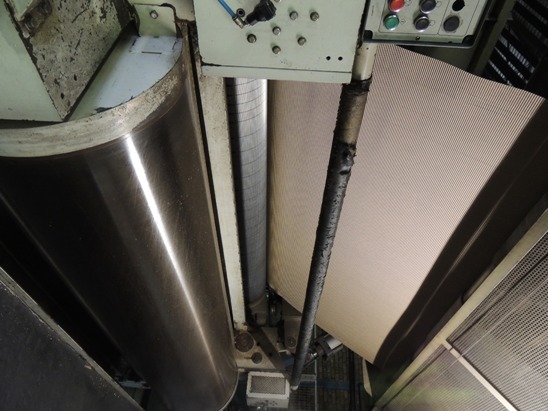
Manufacturing Sector Education and Training Authority (FP & MSETA). Houers also works with Partners for Possibility, which partners businesses with underfunded schools. “The parents of children attending these schools are barely scraping by. They can’t afford to contribute to the upkeep and improvement of facilities and equipment at these schools,” says Mostert. “Houers is partnered with Mahwahwa High School in Mamitwa. We work with the principal in determining how we can assist the school. For example, we impart our skills in business administration, [and] time management.
In collaboration with its suppliers, Houers is at the forefront of the development of paper for use in carton manufacture for the agricultural industry.
A MODEL TO EMULATE
The founding members of Houers invested a total of R730 000 (R13,3 million in today’s terms) in 1982. Since then, they have recouped their investment, saved millions of rands on their carton costs, and shared in the cooperative’s profits. “The benefits of the resultant economies of scale are self-evident. There’s no reason 2017why developing farmers can’t pool their resources in a similar manner to lower input costs or finance a venture further up or down the value chain,” says Mostert.
Thalwitzer concurs with this view, and says that the success of Houers should be instructive for the current generation of farmers.
“Many young farmers today think they can do everything by themselves. They would do well to recognise the advantages of working together.”